The surface request
“We need a new website.”
- Outdated design
- Weak mobile experience
- Generic copy
- Unclear service pages
The flagship engagement
A complete rebuild of how an established service, technical, or product company is understood, trusted, presented, and chosen.
The engagement begins by identifying the company’s strongest commercial substance and determining how that value should be positioned, proven, communicated, and translated into the market.
Selected pre-launch application: When a founder has credible substance and a real market opportunity but no clear name, position, brand, website, or launch system yet, the same method can create the foundation from zero.
Redesigning without fixing the customer, service hierarchy, differentiation, proof, message, and inquiry journey gives the same unclear business a more attractive surface.
The engagement does not begin by selecting pages, colours, or a platform. It begins with the business, buyer, offer, differentiation, proof, and commercial decisions the website must eventually express.
The proprietary methodology
Each stage produces decisions the next stage must express, moving from business reality to market recognition and commercial action.
Customer, service, economic, proof, and market-gap investigation.
Priority customer, value proposition, differentiation, service hierarchy, and narrative.
Projects, reviews, standards, process, objection handling, and reasons to believe.
Messaging, copy, identity, practical brand guidelines, digital expression, and responsive website.
Launch-ready applications, qualification, inquiry routing, analytics, launch, and 30-day stabilization.
The Market Rebuild is not limited to correcting an established market presence. HUMAN shows how the same commercial method can be applied earlier, when the business does not yet have a clear name, position, offer, brand, website, or launch system.
This is the same core offer applied at an earlier business stage, not a separate disconnected service.
See how HUMAN was built ↗
One company, one governing market position, agreed commercial priorities, and one accountable decision-maker.
A usable operating system, not a logo handoff
The Market Rebuild includes the strategic and visual system required to express the company consistently across its website, sales environment, and launch-critical touchpoints.
The strategic foundation gives the identity direction before visual decisions are made.
The existing identity is evaluated honestly. It is retained, refined, or redesigned according to what the company and market position require.
The client receives practical rules and files that internal teams, developers, designers, and production partners can use.
An agreed set is selected during strategy according to the company’s real commercial environment rather than a generic package checklist.
Separately scoped when required
Larger deployment work can extend the approved brand system across a wider sales, product, campaign, or operational ecosystem without turning the initial Market Rebuild into an unlimited production engagement.
The transformation moves through position, service hierarchy, proof, brand expression, customer journey, and inquiry.

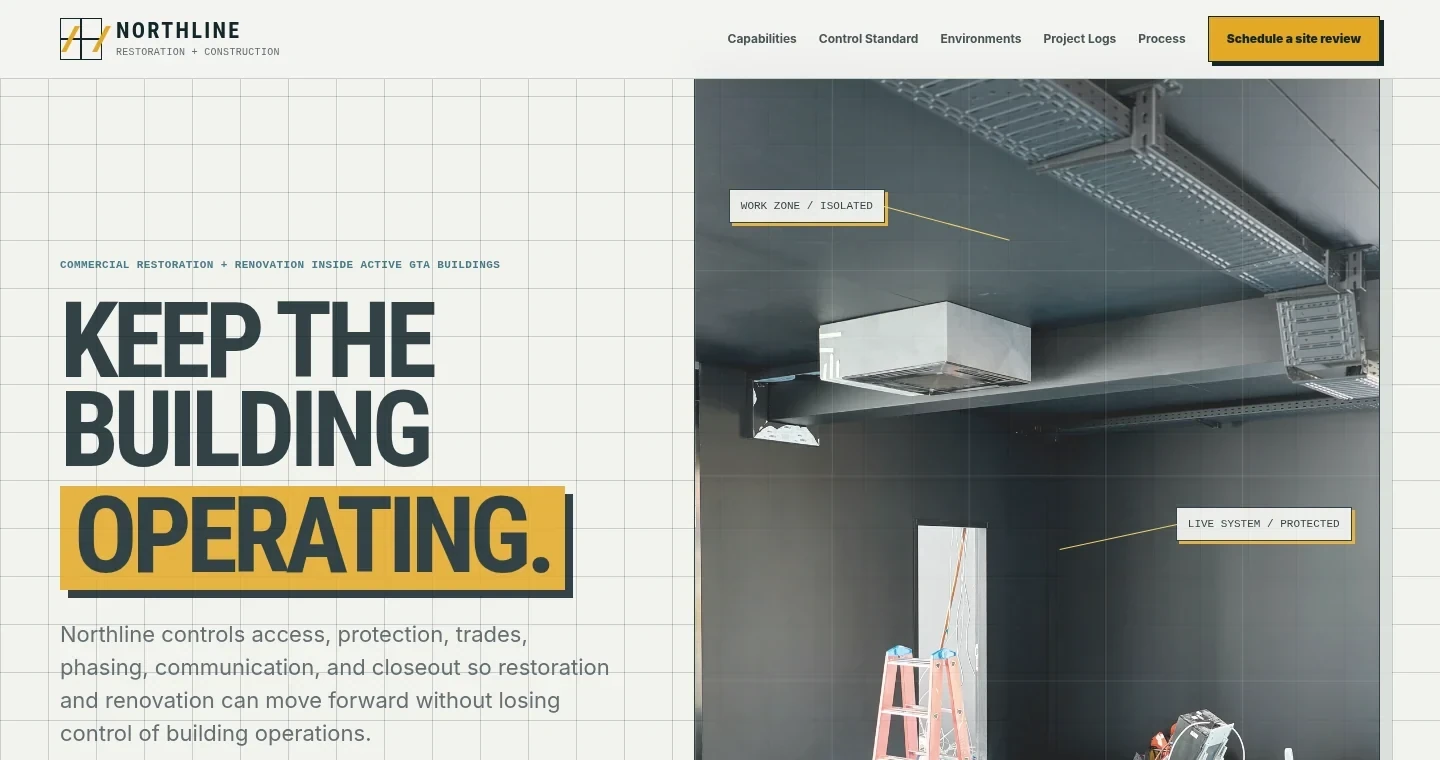
The company needed a priority customer, a valuable operating condition, a service hierarchy, a proof model, an ownable mechanism, and distinct inquiry paths.
Explore the Northline transformation ↗Until real client outcomes can be shown, the clearest proof is the structure and quality of the thinking carried into the engagement.
The priority buyer, work, territory, distinction, commercial stakes, and governing position.
What leads, what supports, how markets or audiences separate, and how the offer should be understood.
Projects, standards, systems, evidence, outcomes, testimonials, and trust-transfer assets.
The core proposition, buyer questions, page logic, service language, and decision-supporting copy.
The identity logic, logo system, typography, colour, graphic language, usage rules, exports, and agreed launch applications.
Qualification, routing, calls to action, forms, measurement, and the path from interest to conversation.
Timing varies with scope, access, content readiness, and decision speed.
Leadership, customers, services, economics, proof, and current sales journey.
Priority customer, market territory, hierarchy, proposition, and differentiation.
Proof, messaging, website structure, objections, inquiry pathways, creative direction, and milestone approval.
After Production Authorization: copy, identity, website production, development, content integration, and review.
QA, analytics, routing, launch, baseline measurement, and stabilization.
Market Stewardship
Market Stewardship is an optional monthly or quarterly continuation for systems Substance & Signal has built or actively governs. It begins after the initial 30-day stabilization period and is scoped around current commercial priorities.
Review analytics, calls to action, form behaviour, inquiry quality, friction, and what the market is responding to.
Add project logs, case studies, testimonials, technical resources, product evidence, capability sheets, and new reasons to believe.
Support new services, products, locations, buyer groups, campaigns, sales materials, or changes in commercial direction.
Protect consistency, add focused pages or applications, review supplier work, and coordinate specialists when deeper production is required.
The engagement protects the client’s time, but it cannot be built from surface-level information.
Direct access to the people who understand customers, economics, and direction.
Services, customers, projects, inquiry patterns, and operational context.
Projects, reviews, certifications, photographs, standards, and processes.
A single accountable person who consolidates feedback and protects coherent decisions.
Position, message, creative direction, design, and launch choices made within the process.
Clear acknowledgement of what the company can genuinely promise, prove, and fulfil.
The Market Position Review determines whether the full intervention is justified.
No. Website development begins once the company already knows what the site should communicate and how it should work. The Market Rebuild first determines what the company should be known for, which customers and services should be prioritized, why buyers should prefer it, what proof creates confidence, and how the journey should move toward inquiry. The website is one implementation of that commercial system.
Brand identity is part of the engagement, but it follows the commercial position. Branding shapes how the company looks and feels. Positioning determines what the company should mean in the buyer’s mind and why it should be preferred.
The Market Rebuild supports marketing, but it is not primarily an advertising or campaign service. Marketing creates attention. The Market Rebuild determines what that attention should understand, believe, and do once it reaches the company.
Yes, selectively. HUMAN demonstrates the same Market Rebuild method applied at an earlier stage: practitioner or founder substance, market gap, positioning, naming, mechanism, identity, website, launch collateral, and customer journey developed together before the business enters the market. It remains the same core engagement, not a disconnected second offer.
Yes, when the identity can support the desired market position. The logo is evaluated rather than automatically replaced. Refinement or redesign is recommended only when commercially justified.
Yes. The Market Rebuild includes practical brand guidelines and organized logo and identity exports so internal teams and future suppliers can use the system consistently.
An agreed launch-ready set is selected during strategy according to the company’s commercial needs. It may include business cards, email signatures, social profiles, a capabilities sheet, proposal cover, project template, product sheet, or another priority application.
Large collateral families, catalogues, campaign systems, signage, vehicle graphics, trade-show systems, packaging, photography, video, printing, fabrication, paid media, ongoing SEO, ecommerce, custom software, and complex integrations are scoped separately when required.
Michael leads investigation, positioning, messaging, copywriting, and creative direction. Specialists enter when execution requires additional development, photography, production, SEO, analytics, or technical expertise.
Yes, when roles, standards, ownership, access, and decision-making are clear. Responsibility for implementation is defined before work begins.
Fifty percent reserves the engagement and begins strategic work. The remaining fifty percent becomes due at Production Authorization, after the governing strategy, website architecture, messaging direction, and creative system have been reviewed and approved. Full production proceeds after the second payment.
The engagement includes 30-day stabilization for quality assurance, analytics, form and inquiry routing, launch monitoring, minor corrections, and baseline refinement. Market Stewardship is the optional continuation after that period.
The Market Position Review does not assume that a rebuild is necessary. If the company would be better served by a specialist, a strategic advisory engagement, a smaller correction, or no immediate intervention, that will be recommended instead.
It guarantees milestone approval before full production, written authorization before additional fees, delivery of the agreed handoff, and correction of implementation defects within the approved scope during the 30-day stabilization period. It does not guarantee leads, revenue, traffic, rankings, or outcomes outside Substance & Signal’s control.
The Market Rebuild Delivery Assurance
The assurance applies to the decisions, deliverables, scope control, implementation quality, and post-launch correction that Substance & Signal can directly govern.
The governing market position, information architecture, messaging direction, and creative system are reviewed before the engagement moves into full production.
Work beyond the approved scope is identified, presented, and authorized in writing before additional professional fees are incurred.
At completion, the client receives the agreed website, identity system, practical guidelines, exported files, and launch-ready applications.
Any implementation defect within the approved scope identified during the 30-day stabilization period is corrected at no additional professional fee.
Payment is structured 50% to begin and 50% at Production Authorization. Final investment depends on commercial complexity, content readiness, technical requirements, and production needs. Multi-brand architecture, large collateral families, photography, video, printing, fabrication, ecommerce, custom software, and complex integrations are scoped separately.